


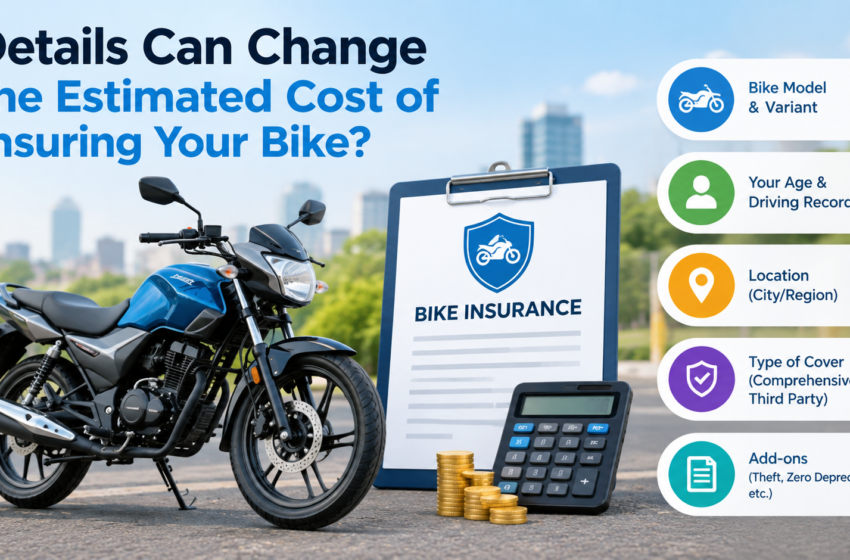
What Details Can Change the Estimated Cost of Insuring Your Bike?
Say two people on your street pick up the same 125cc scooter, same month, same showroom. Come renewal, one of them is quoted a good deal more than the other. Neither can work out why.
The number an insurer quotes you isn’t pulled out of thin air. It’s built from a short list of details about your bike, your address and your claim record, and each one pushes the price in a particular direction. Here’s what sits on that list, roughly in the order of how much each one moves your total.
Table of Contents
Which Part of the Premium Is Fixed, and Which Part Isn’t?
Two parts, and only one of them is open to competition. Third-party cover is set by the insurance regulator(IRDAI), so the rate for a given engine size is the same whichever company you buy from. Own damage cover is priced by the insurer. That’s where quotes start to differ.
Every two wheeler insurance policy has to include third-party cover, because riding without it isn’t legal in India. Those rates are notified centrally and revised from time to time, in bands based on engine capacity. Comprehensive policies stack own damage cover on top, priced from each insurer’s own claim experience. So, when two quotes on the same bike don’t match, the gap almost always sits in the own damage half.
How Much Does the IDV Change Your Estimate?
Quite a lot. IDV, or Insured Declared Value, is what your insurer would pay if the bike is stolen or written off. It’s usually the largest single influence on the own damage part of your premium.
The starting point is the price the manufacturer listed, and from there the figure slides down year after year on a set depreciation scale. Take a bike that costs around ₹90,000. Four years on, its IDV might sit nearer ₹55,000, though the real number shifts with the model, the condition and the insurer you ask. Most insurers also give you a bit of room to move the IDV up or down inside a fixed band.
Choosing the lowest option trims your premium, and it also trims what you receive in a total loss claim. Terms and conditions apply. Please refer to the policy wording for full details before purchase.
Do Engine Size and the Bike’s Age Pull in the Same Direction?
Not quite. Engine capacity sets your third-party rate, which is why a 110cc commuter and a 500cc machine sit in different bands from the start. Age works through IDV instead.
An older bike carries a lower IDV, so its own damage premium is smaller than a new one’s. The trade-off is a smaller settlement if the bike is ever written off. Insurers may also ask for an inspection on older vehicles before renewal, and what the inspector notes can feed back into the quote.
Why Does Your Address Change the Price?
Location matters more than most riders expect. Insurers sort RTO locations into zones, and the zone on your registration certificate feeds straight into the quote. Cities with dense traffic, higher theft rates and more frequent claims sit in the costlier zone. Smaller towns generally sit lower.
That’s why the same scooter can quote differently in Mumbai and in a district town a few hours away. If you’ve moved cities and re-registered the bike, your renewal figure can shift even though nothing about the bike has changed. Running a bike insurance premium calculator with your current pincode is a quicker way to check that than assuming last year’s number still holds.
What Do No Claim Bonus and Deductibles Do to the Number?
Both bring the premium down, but they work at different ends of the policy. No Claim Bonus is a discount you build up for each consecutive claim-free year, rising in steps until it reaches a ceiling. A deductible is the slice of any claim you agree to pay yourself.
- NCB belongs to you, not the bike, so it carries over when you switch insurers
- Renewing late enough to break continuity can cost you the bonus you’ve built
- One claim resets the bonus, which is why riders often absorb very small repairs themselves
- A voluntary deductible lowers the premium now and raises your share at claim time
- The compulsory deductible applies either way and doesn’t move with your choices
Terms and conditions apply. Please refer to the policy wording for full details before purchase.
Which Add-Ons Add the Most?
Add-ons are optional covers you buy on top of a comprehensive policy, and every one of them adds to the base price. Zero depreciation is usually the priciest, because it removes the depreciation deduction on replaced parts. The others cost less individually. The total climbs quickly if you tick several boxes, and these are the ones you’ll see most often:
- Zero depreciation cover
- Engine and gearbox protection
- Roadside assistance
- Consumables cover for items like engine oil and nuts and bolts
- Personal accident cover for a pillion rider
What’s on offer, and what each one costs, differs by insurer and by bike. Terms and conditions apply. Please refer to the policy wording for full details before purchase.
Pulling Your Own Estimate Together
Most of the movement in a bike quote comes from a handful of things: the IDV you settle on, the engine size and registration zone of the bike, and the claim-free years behind you. Add-ons and deductibles adjust the rest. Once you can see which of these apply to your situation, the estimate stops looking arbitrary and starts looking like arithmetic.
The useful next step is to feed your own details into a bike insurance premium calculator and change one variable at a time. Raising the IDV or removing an add-on shows you what that single choice is worth in rupees. It’s a far clearer picture of your two wheeler insurance cost than any general rule of thumb.
